


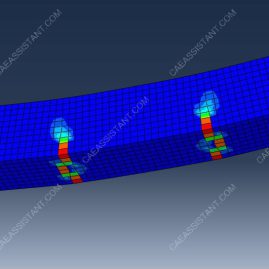
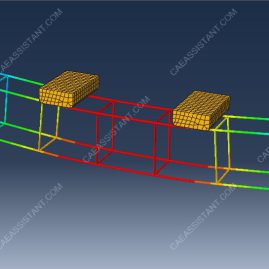
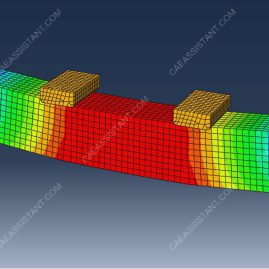
In this tutorial, the numerical simulation of a reinforced foamed concrete beam with partial cement replacement is presented. Concrete is one of the most widely used construction materials in the world today. It is a key element in civil engineering structures such as bridges, dams, roads, and high-rise buildings. The popularity of concrete is due to its high durability, strength, moldability, and cost-effectiveness compared to other traditional materials.
Among the various types of concrete developed over time, foamed concrete is a lightweight variety with a dry density ranging from 300 to 1800 kg/m³ — up to 87% lighter than normal concrete. It is typically produced using cement as a binder and sand as a fine aggregate. Cement plays a crucial role as it binds all other ingredients together to form a solid, stone-like material. However, the production of cement raises environmental concerns due to its high carbon emissions.
To address this issue, supplementary cementitious materials (SCMs) such as industrial and agricultural waste can be used to partially replace cement. In this study, a finite element model of a reinforced foamed concrete beam incorporating palm oil fuel ash (POFA) and eggshell powder (ESP) as partial cement replacements was developed using ABAQUS Explicit software.
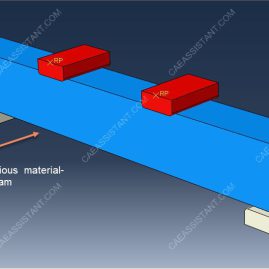
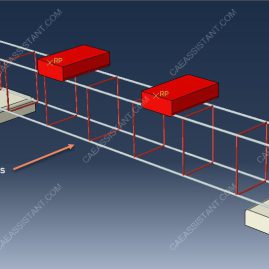
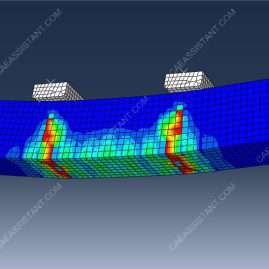
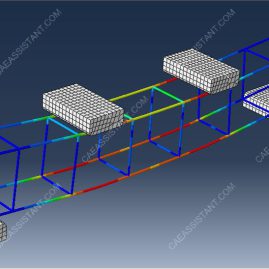
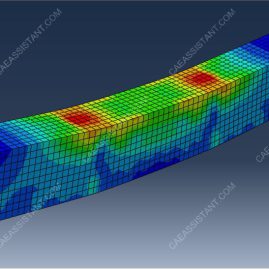
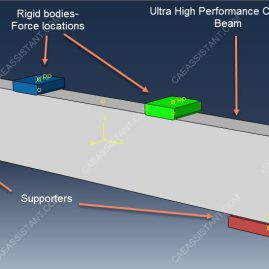
The concrete beam is modeled as a three-dimensional solid part, while the steel reinforcement bars and strips are modeled as three-dimensional wire parts. The Concrete Plastic Damage (CPD) model is applied to the beam. The steel components are defined with elastic–plastic material properties. The simulation uses a general static step with adjusted convergence settings. Surface-to-surface contact is defined between the rigid bodies and the beam with an assigned friction coefficient. The steel bars and strips are embedded within the concrete beam. Boundary conditions include fixed supports at the two lower rigid bodies and displacement loading at the two upper rigid bodies. A fine mesh is applied to ensure accurate results.
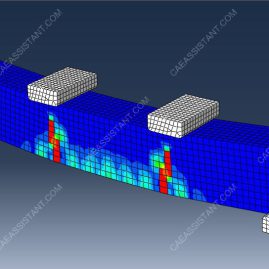
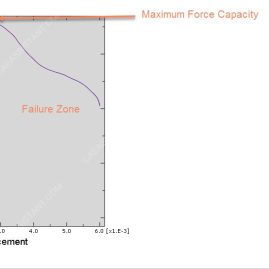
After the simulation, results such as stress, strain, tensile and compressive damage of the concrete beam, and the force–displacement diagram are obtained. These results provide valuable insights into the behavior and performance of reinforced foamed concrete beams with partial cement replacement materials.
Reviews
There are no reviews yet.