


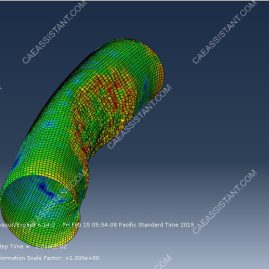
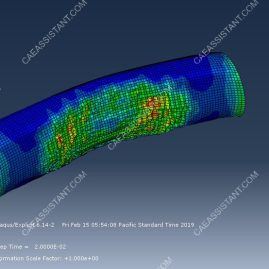
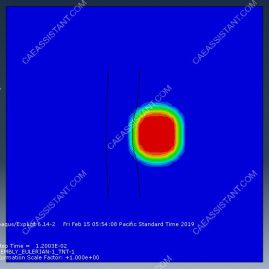
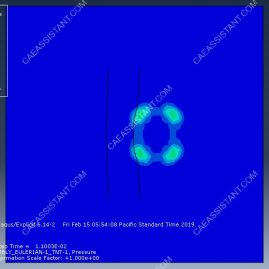
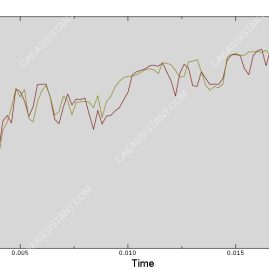
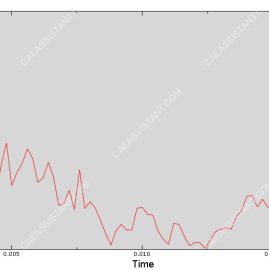
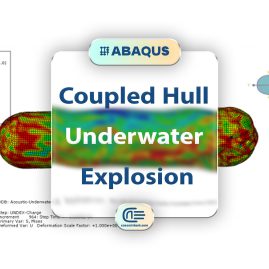
In this tutorial, the numerical simulation of a Coupled Eulerian-Lagrangian (CEL) explosion over a metal tube submerged in water has been studied using Abaqus.
An underwater explosion can be divided into two main stages: the shock wave and the bubble pulse. Both stages can cause severe damage to nearby structures, but their mechanisms differ.
The shock wave produces very high pressure with a very short duration.
The bubble pulse generates lower pressure (about 10%–20% of the shock wave) but lasts much longer, creating a force with comparable momentum.
Because of these differences, both the shock wave and bubble pulse must be considered when analyzing near-field underwater explosions.
The shock wave usually causes local damage to structures with natural periods in the millisecond range, such as ships. In contrast, the bubble pulse can lead to global damage, producing whipping motions if its frequency approaches the ship’s eigenfrequency.
In recent years, researchers have focused on the role of fluid-structure interaction (FSI) in blast response. Taylor was among the first to study the momentum transferred to a freestanding plate from a pressure wave with an exponential profile.
For this analysis, the dynamic explicit procedure in Abaqus is appropriate. General contact with default properties was applied. The following material models were used:
Air: Ideal gas data
Explosive (TNT): JWL equation of state
Water: Us–Up parameters
Aluminum tube: Johnson–Cook plasticity model
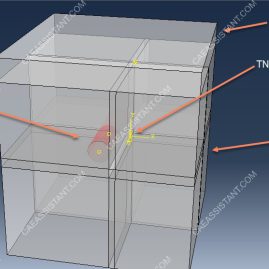
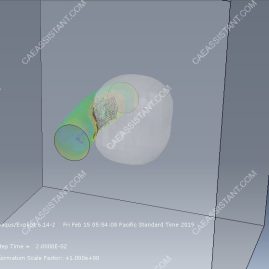
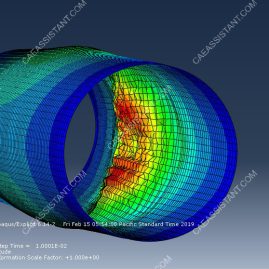
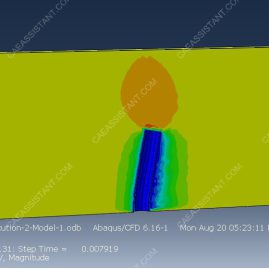
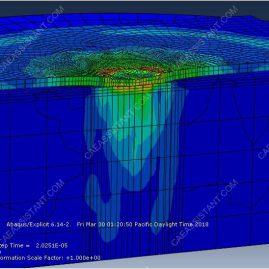
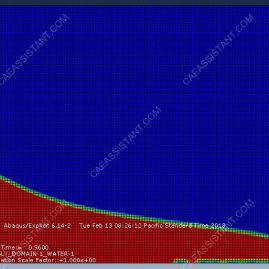
After detonation, the shock wave propagated through the water. The pipe experienced significant deformation and compaction upon contact with the shock waves. Figures of the assembled part and simulation results are shown below.
Reviews
There are no reviews yet.