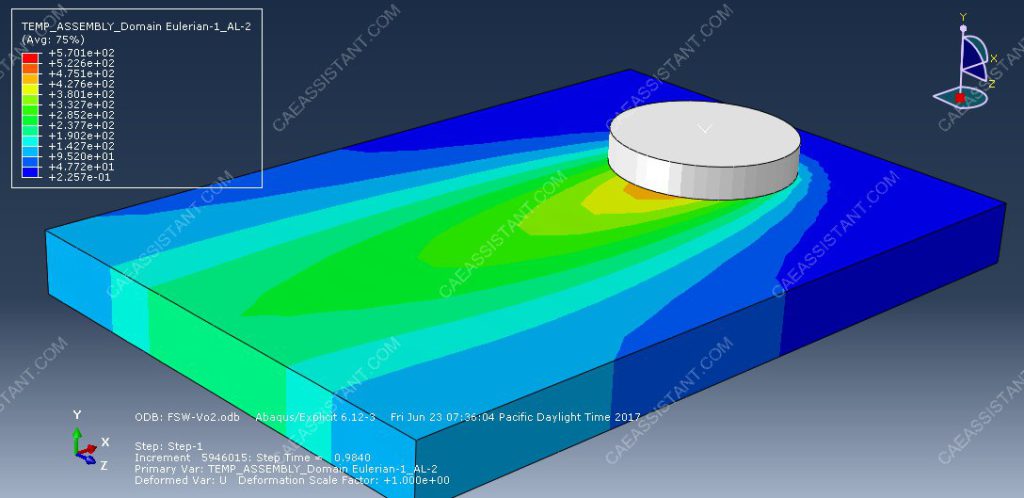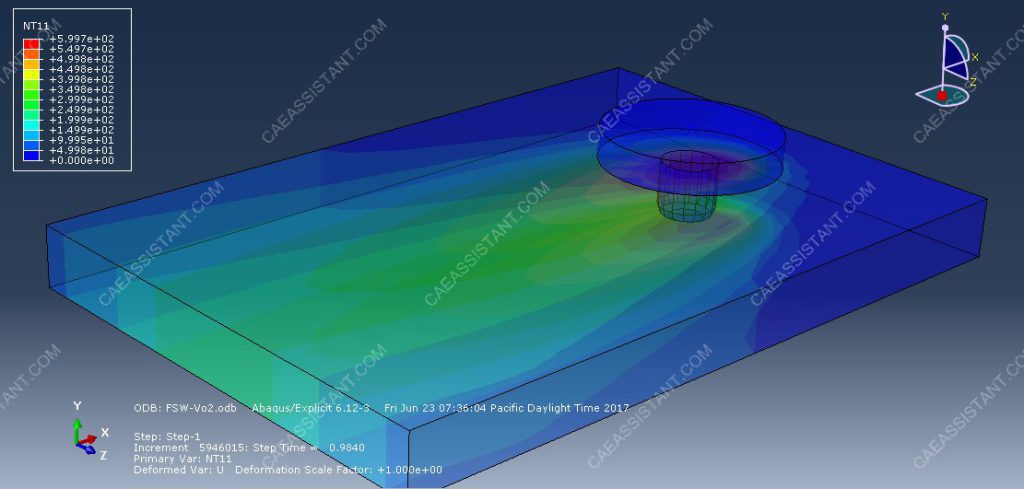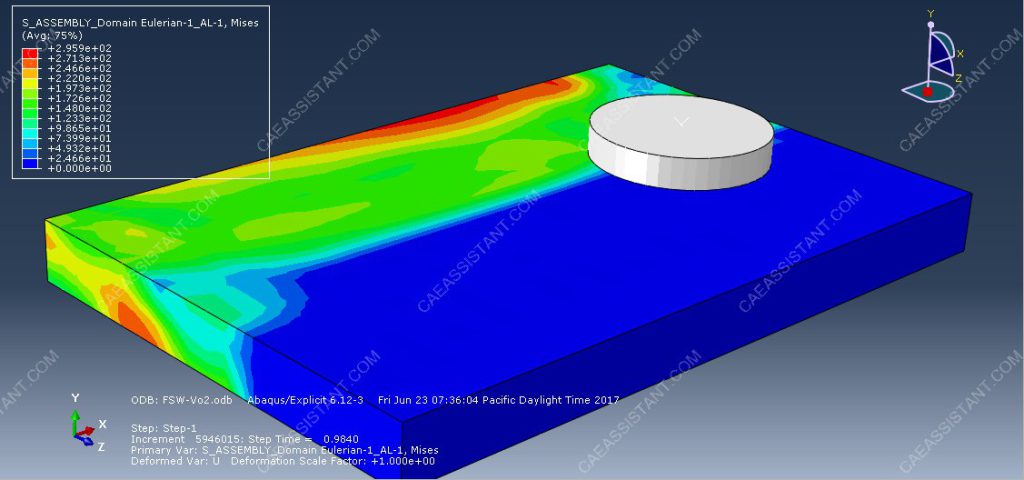
Friction Stir Welding (FSW) is a multi-physics problem that involves both material deformation and heat flow. In this work, a Coupled Eulerian–Lagrangian (CEL) model is developed in the Abaqus environment to simulate the two main phases of the FSW process: plunging and welding.
The provided tutorial includes a CAE file and an English step-by-step video demonstrating the welding of two aluminum plates. During the analysis, the tool moves and rotates through the plates, generating heat and enabling the welding process.
FSW is a solid-state welding technique, widely recognized as an effective method for joining similar or dissimilar metals and alloys with varying physical, chemical, and mechanical properties. It is a complex process that combines thermal and mechanical phenomena: intense material deformation around the pin tool and significant heat generation.
Finite Element Modeling (FEM) of FSW helps researchers and engineers better understand how process parameters affect the welding operation and the quality of the weld seam. Today, FSW FEM approaches are generally classified into three categories:
- Thermal models
- Thermo-mechanical non-flow-based models
- Thermo-mechanical flow-based models
Below, you can see some example images of the simulation results.