Spot welding is a fast and reliable method for joining lightweight metallic parts. It plays a key role in industrial manufacturing, especially in the automotive sector. The most commonly used technique is electrical resistance welding. However, it has limitations—particularly when welding metals with significantly different melting points or oxidized surfaces.
To overcome these challenges, alternative methods such as explosive welding, laser spot welding, and impact spot welding have been developed. Among these, impact spot welding offers high-quality, stable, and durable joints by forming solid-phase bonds and surface interlocks.
In this method, a high-velocity projectile or water slug strikes a specific point, generating intense pressure that creates a permanent bond in the surrounding area. The pressure from the liquid jet impact lasts only a brief moment but is followed by rapid radial flow, often exceeding the initial impact speed.
Eulerian analysis is well-suited for modeling fluid flow and extreme material deformation. In this approach, mesh nodes remain fixed in space while the material flows through the elements. This prevents mesh distortion and allows accurate simulation of high strain rates.
In contrast, Lagrangian analysis keeps nodes attached to the material, so the mesh deforms with it. This method is ideal for solid-state problems. However, when solid materials behave like fluids due to high strain rates, a Coupled Eulerian-Lagrangian (CEL) approach is more effective.
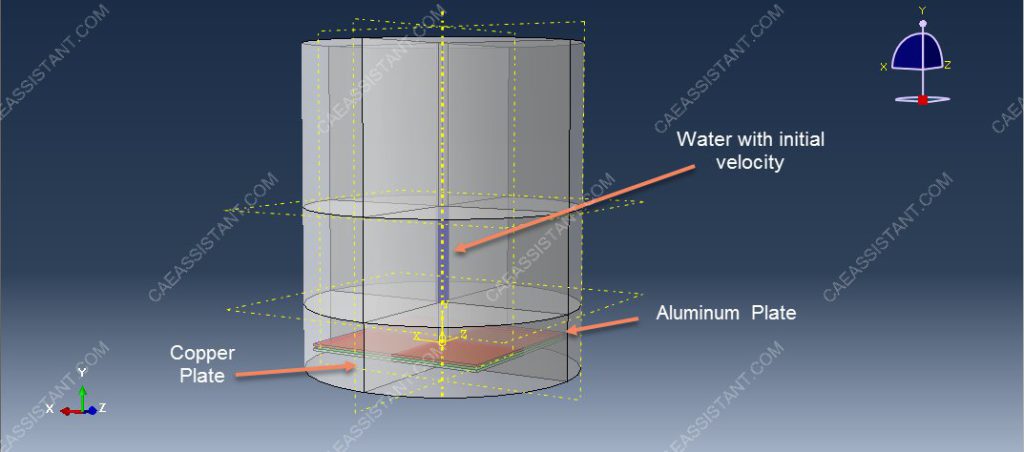
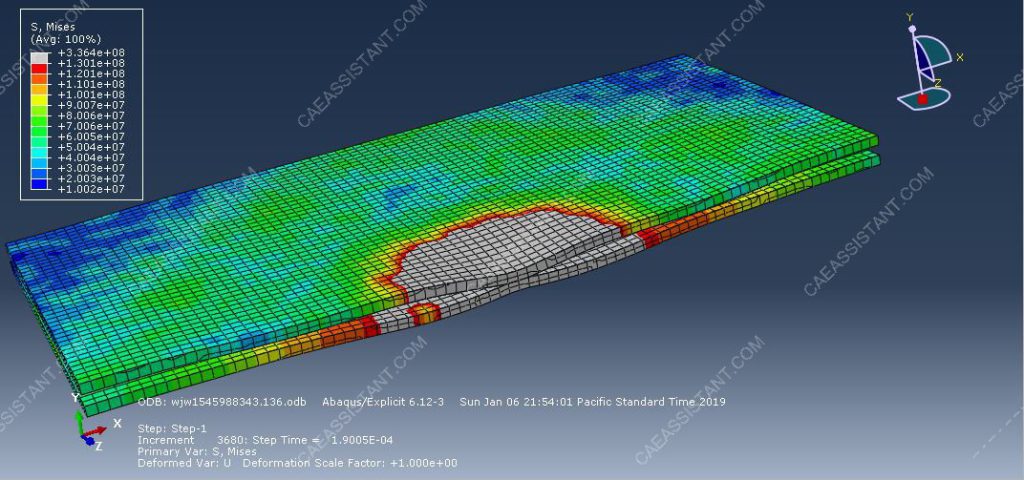
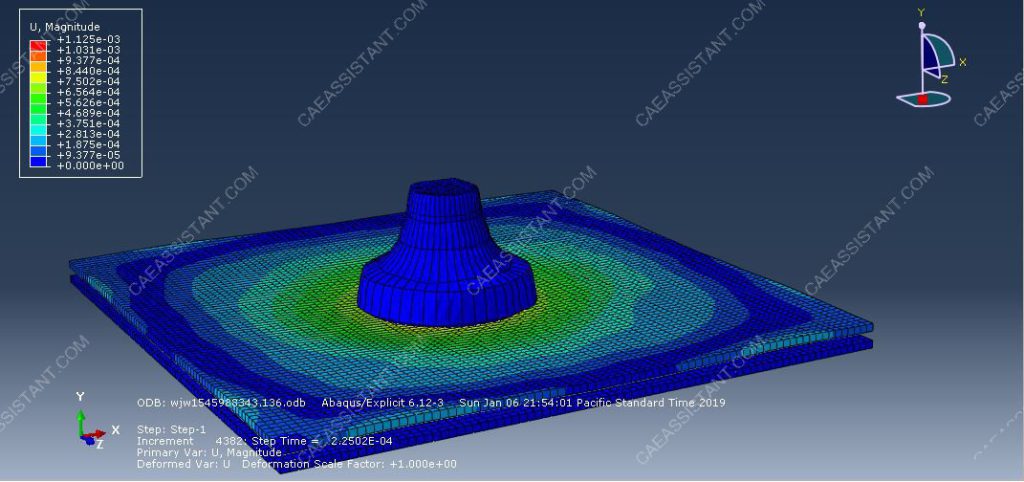
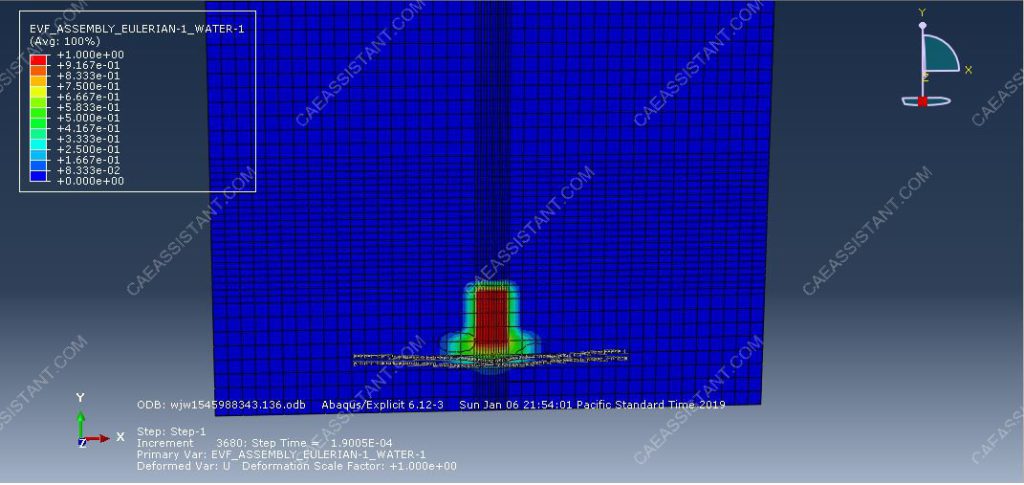
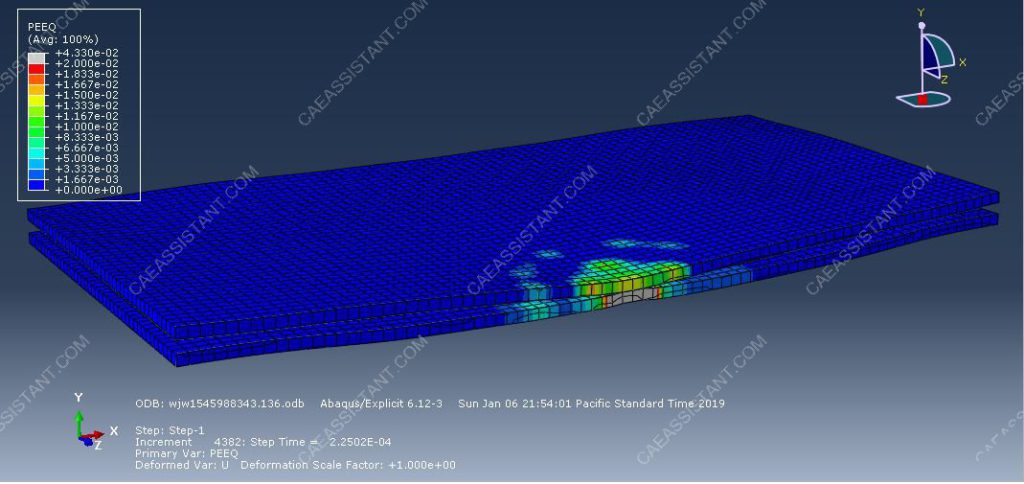
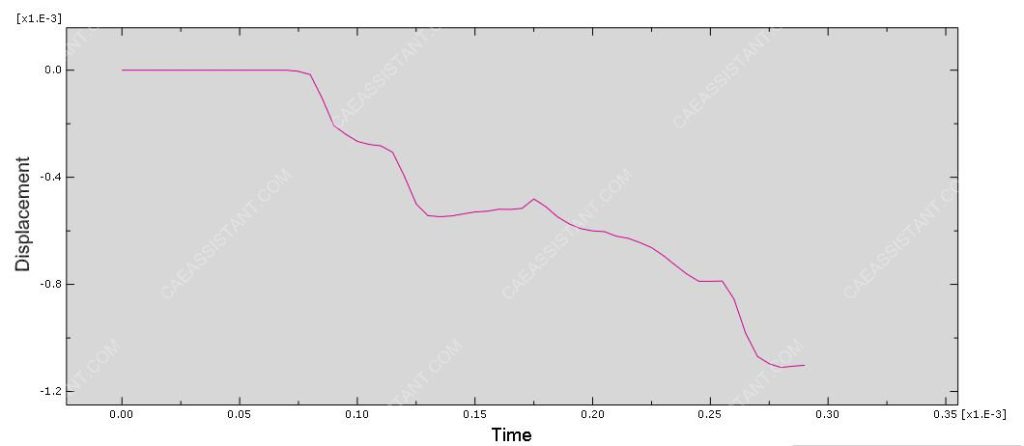
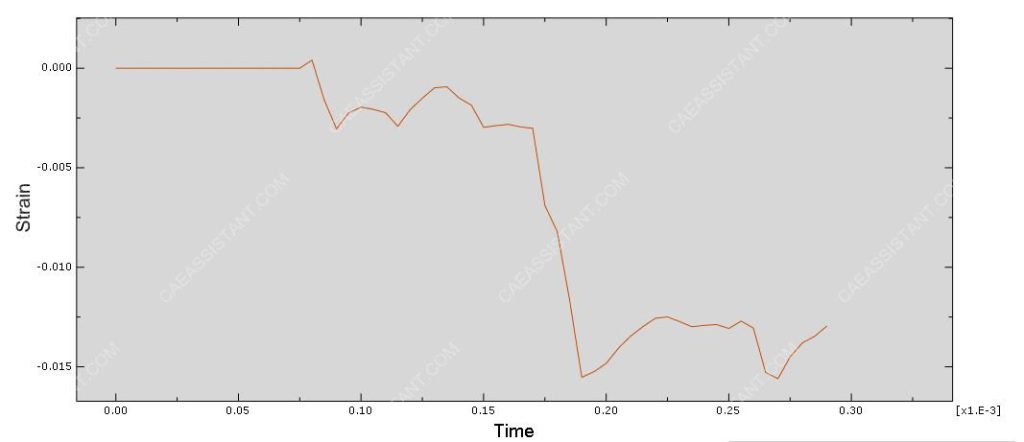
This simulation uses the CEL method. The assembly includes a flyer plate and a base plate. A dynamic explicit step is defined, with surface-to-surface contact and frictional behavior to simulate realistic interaction. Water is modeled as an Eulerian part with an initial velocity. During impact, the flyer plate penetrates the base plate, generating high stress in the contact zone. This stress leads to a permanent joint between the plates.